
Massachusetts Traffic Ticket Records
Massachusetts traffic ticket records are official documents created when a law enforcement officer issues a citation on a public road. The state calls these citations "Civil Motor Vehicle Infractions," or CMVIs. Each ticket is a five-page computer-generated form. Copies go to the court, the issuing agency, the Registry of Motor Vehicles, the driver, and the officer. You can look up Massachusetts traffic ticket records through the state's court portal, the RMV, or by contacting the district court that handled your citation.
Massachusetts Traffic Ticket Records Overview
Where to Find Massachusetts Traffic Ticket Records
There are two main ways to search Massachusetts traffic ticket records: the MassCourts case access portal and the MyRMV online portal. Both are free to use. MassCourts lets you look up cases by name, citation number, or case number. The MassCourts case access portal covers all district and Boston Municipal Court divisions across the state. Results show docket entries, hearing dates, and the current status of the case. You do not need an account to search.
The MassCourts case access portal is the go-to tool for finding records tied to a specific citation number.
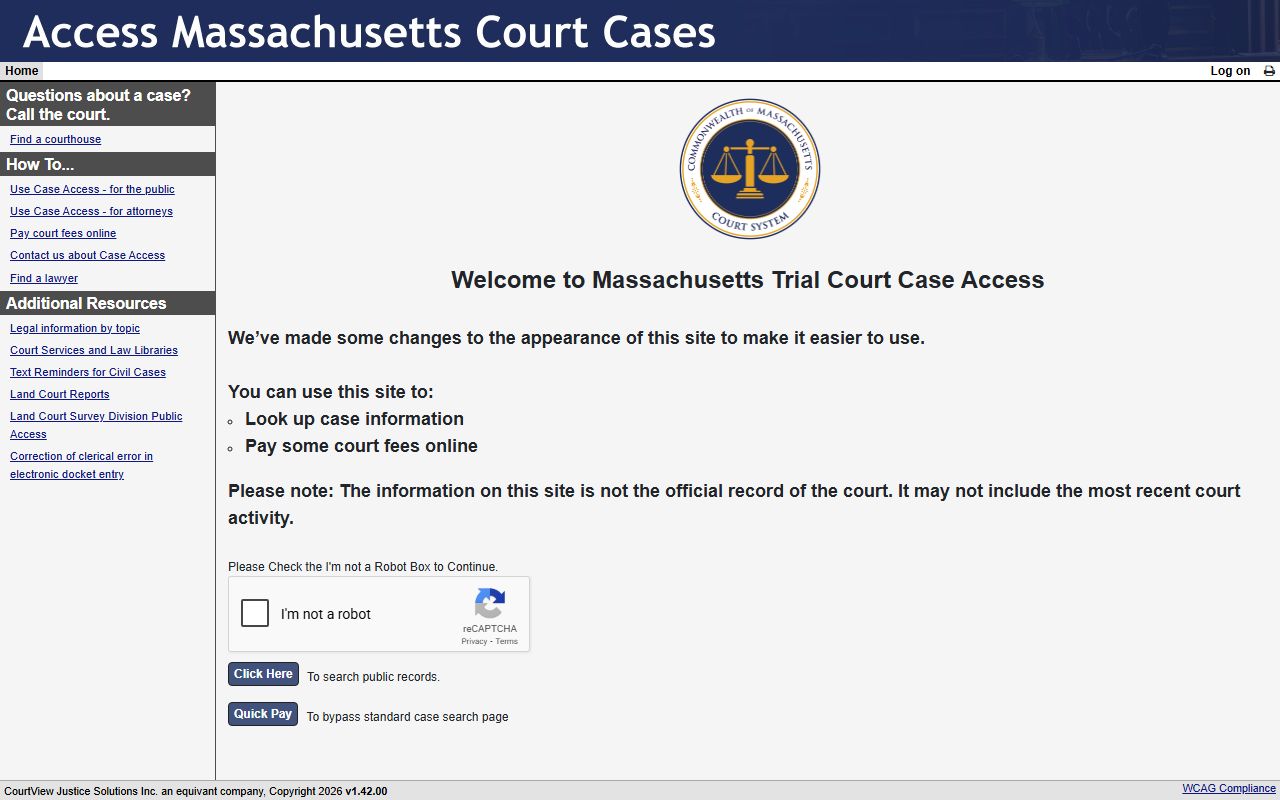
MassCourts is maintained by the Massachusetts Trial Court and is updated regularly as cases move through the court system.
The Massachusetts Registry of Motor Vehicles is the other key source. The RMV keeps records of all surchargeable events tied to your license. These include moving violations, at-fault accidents, and other incidents reported by courts and insurers. Your driving record at the RMV reflects what courts have reported, so a paid or dismissed ticket should eventually show the correct status there as well.
The RMV's online portal, MyRMV, gives licensed drivers direct access to their own records.
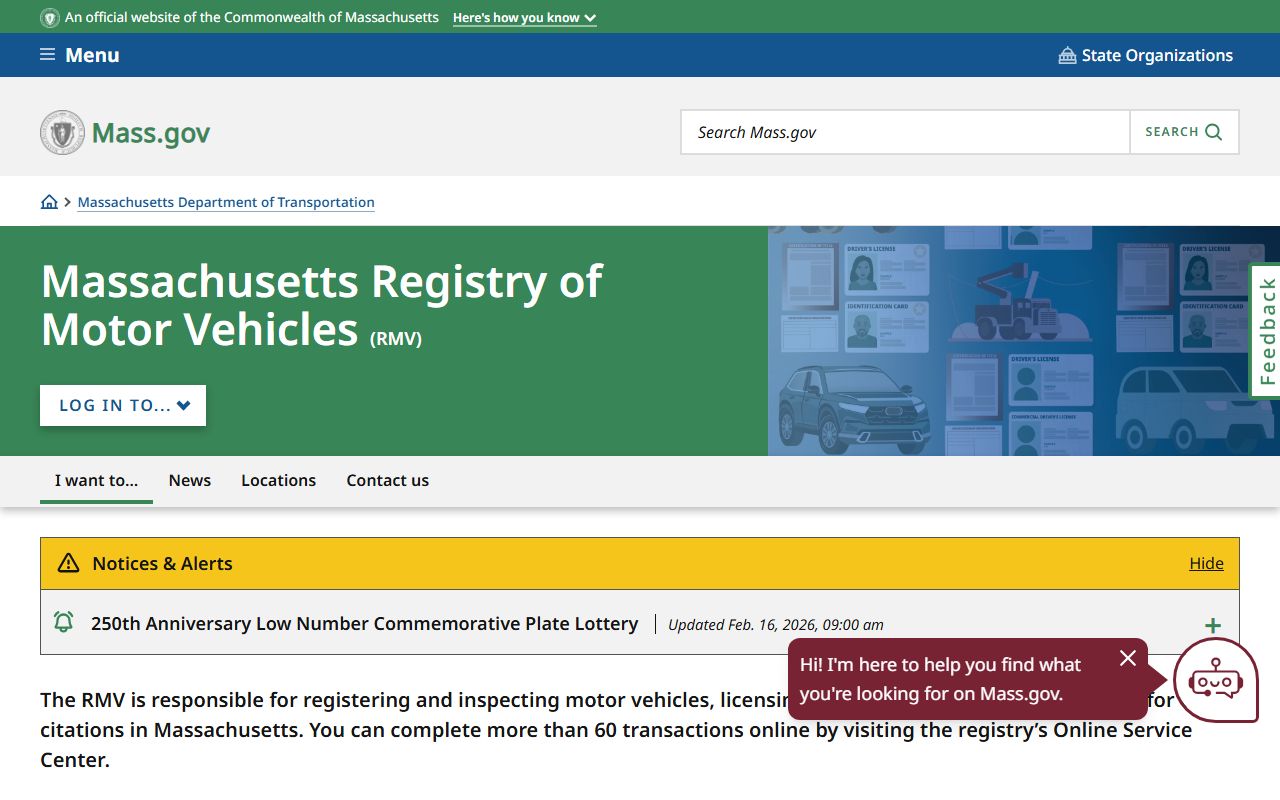
You can log into MyRMV with a Mass.gov account to view your license status, check surcharges, and manage citation payments.
How to Pay Massachusetts Traffic Ticket Records
When you get a Massachusetts traffic ticket, you have 20 days to respond. You can pay the fine or choose to appeal. If you want to pay online, you must wait at least 10 days after the ticket was issued before the system will accept your payment. The mass.gov traffic tickets page walks through all your options in plain language.
The main traffic tickets portal is the best starting point for understanding what to do after receiving a citation.
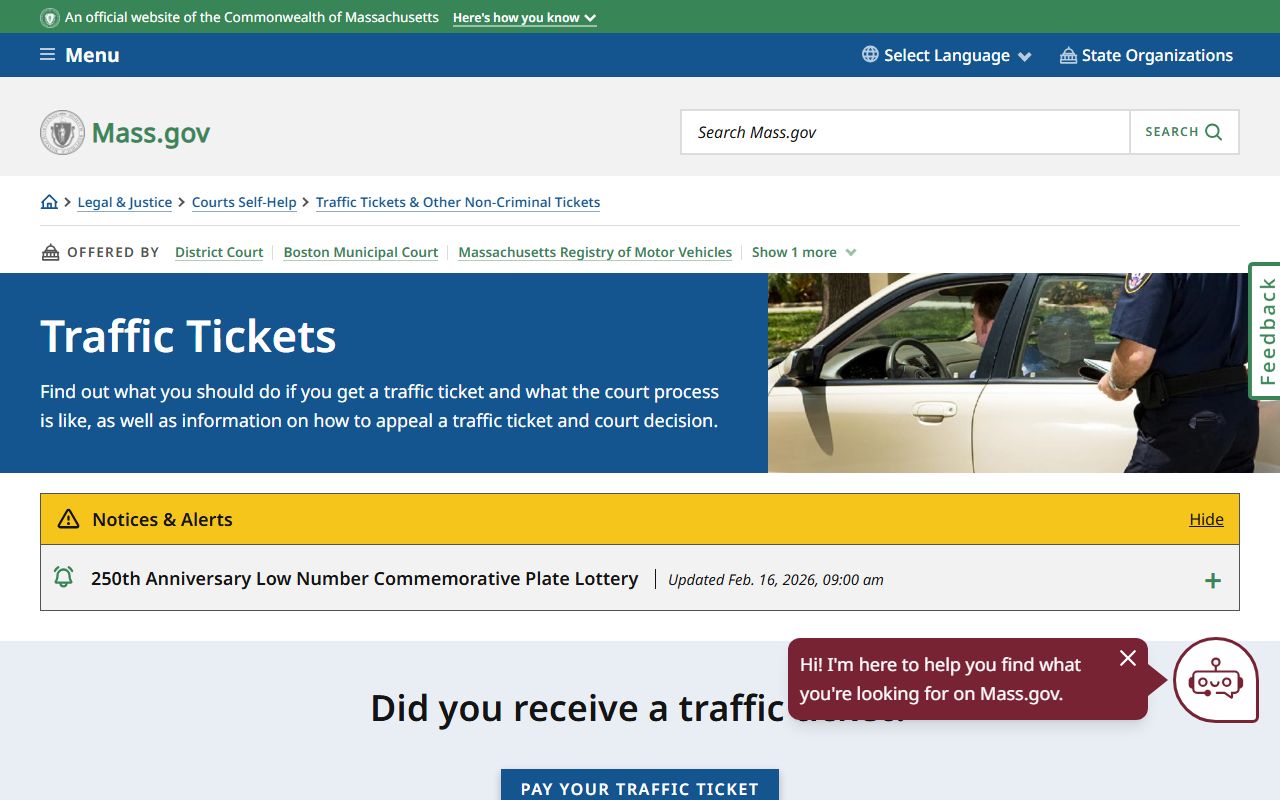
The portal links directly to payment, appeal, and hearing options so you can act quickly without navigating multiple websites.
You have several ways to pay. Online is the fastest method. Go to MyRMV citation payment and enter your citation number. By mail, send a check or money order to the citation payment center at P.O. Box 55890, Boston, MA 02205-5890. You can also pay by phone using a credit card. If you do not respond within 30 days, the RMV may suspend your license. A late fee will also apply on top of the original fine amount.
Detailed step-by-step instructions are available on the pay your traffic ticket page.
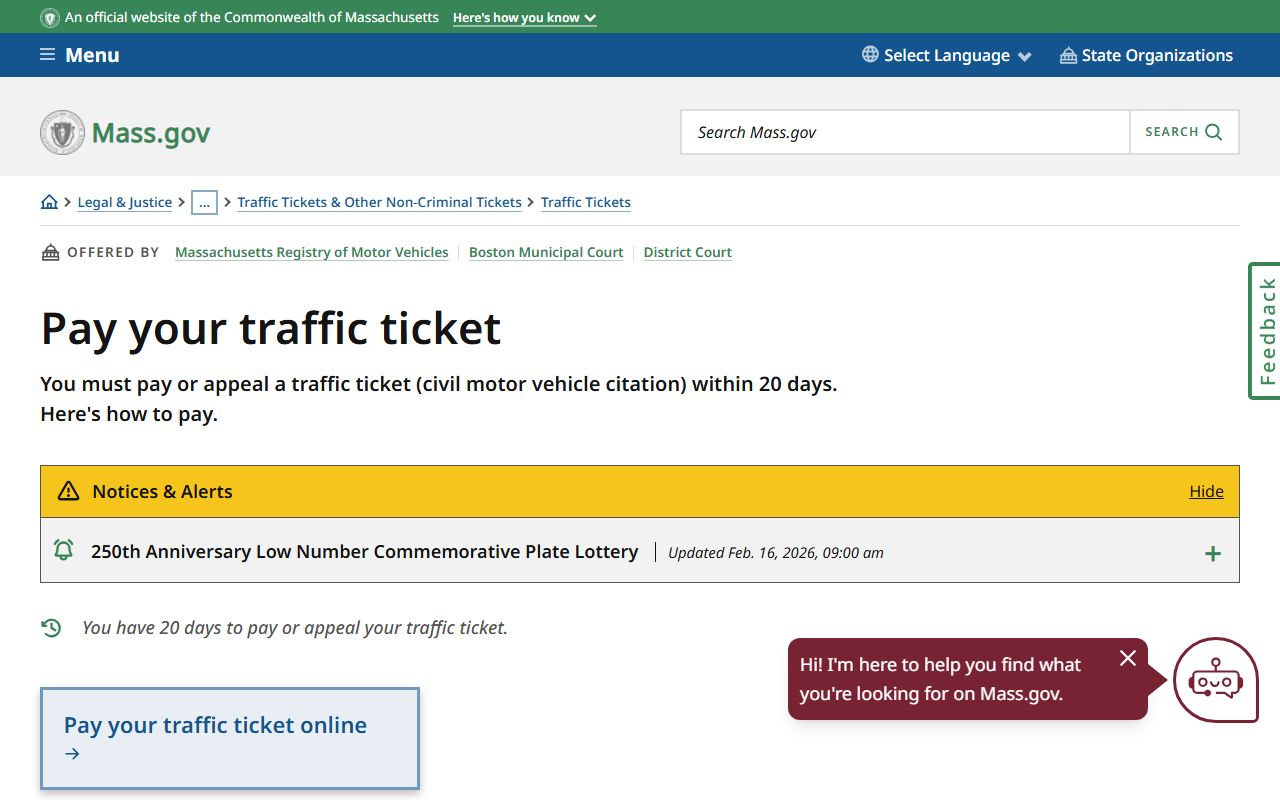
The payment page explains exactly what information you need and which payment methods are accepted for each type of citation.
Appealing Massachusetts Traffic Ticket Records
Massachusetts gives drivers up to four ways to fight a traffic ticket. The process is spelled out at mass.gov/how-to/appeal-your-traffic-ticket. You start by requesting a Clerk-Magistrate Hearing. This costs $25, and the fee is non-refundable. The hearing is informal. The officer who wrote the ticket usually does not show up. The standard used is whether the violation is "more likely than not" to have occurred. If the clerk finds you not responsible, the fine is waived and the $25 fee is refunded for tickets issued after September 22, 2017.
If the clerk finds you responsible and you disagree, you can appeal to a judge. That step costs $50. Unlike the clerk hearing, the officer must appear at a judge appeal. If the officer does not show up, the case is dismissed. This makes judge-level appeals worth pursuing when you believe the officer may not attend. After that, you can go to the Appellate Division for $180 or to the Appeals Court for $300. Each step moves the case up the court system and requires a stronger legal argument.
The appeal instructions page has the full breakdown of each step and what to bring.
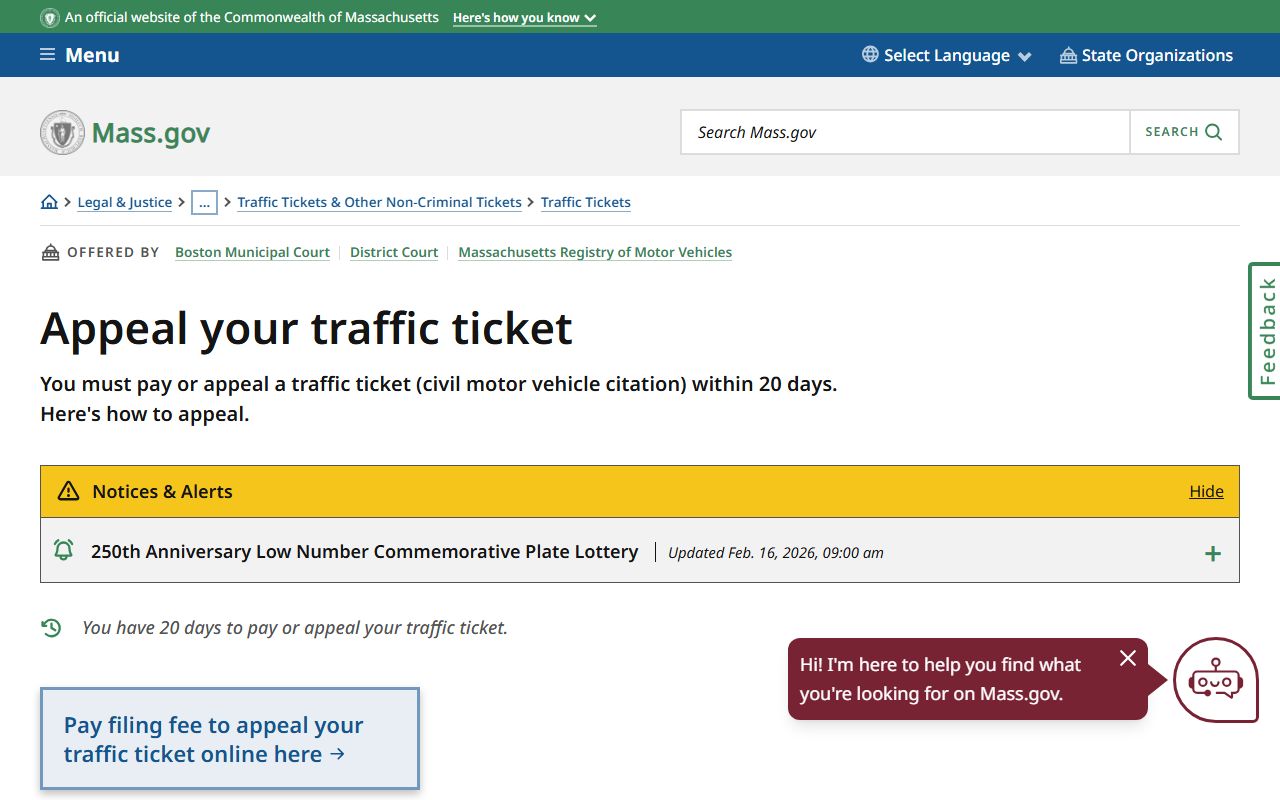
Knowing which step to start at can make a big difference in both cost and outcome.
Before your hearing, it helps to know what to expect. The traffic ticket hearing info page covers what happens in the room, what questions the clerk might ask, and how to present your case.
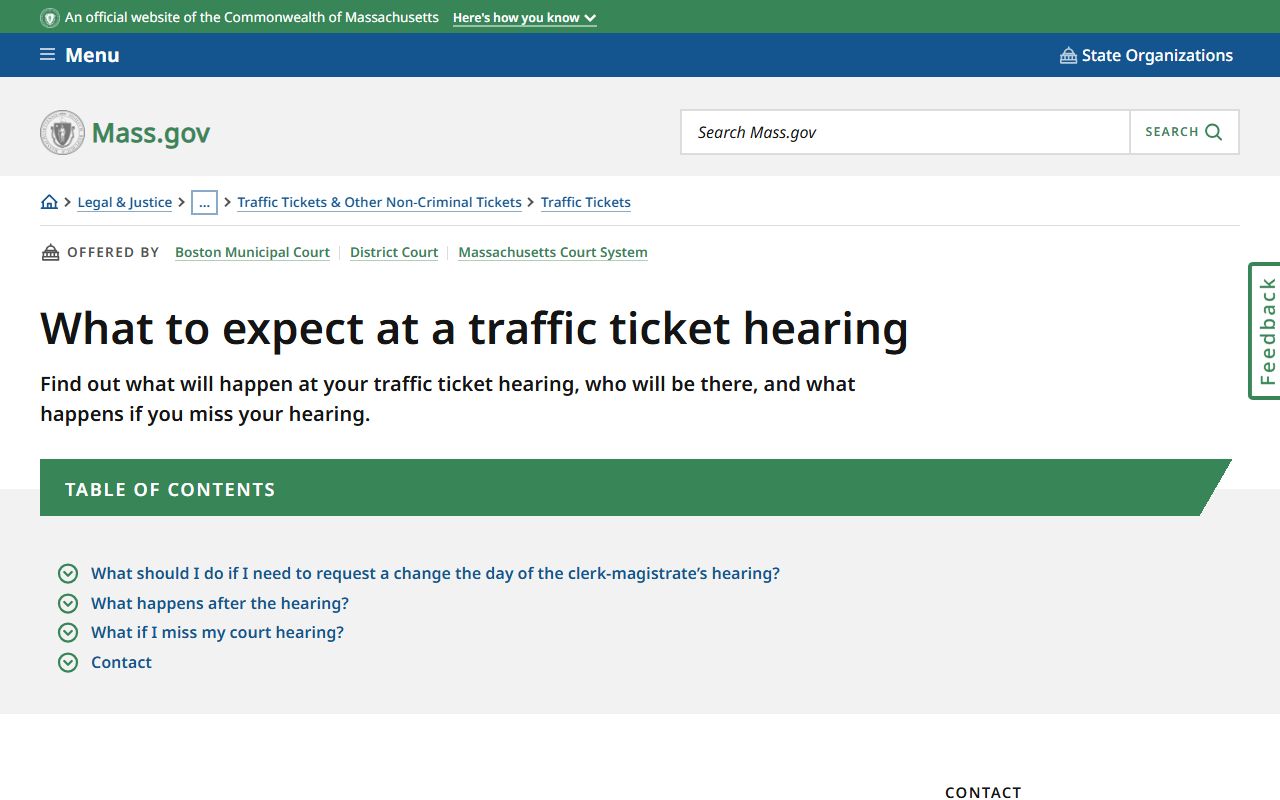
Most Clerk-Magistrate hearings are short. Coming prepared with a clear account of what happened gives you the best shot at a favorable result.
Massachusetts Driving Records and Citation History
Your driving record at the RMV is a complete history of your license status, surchargeable events, and any suspensions or restrictions. You can get an unattested copy online for $8 or an attested (certified) copy for $20. The RMV driving records page explains how to request a copy online, by mail, by phone, or in person at an RMV service center. By phone, call (857) 368-8000 or toll-free at (800) 858-3926. TTY users can call (877) 768-8833. Online requests through MyRMV are processed quickly. Mailed requests take longer.
The driving records request page lists all options for getting your official record.
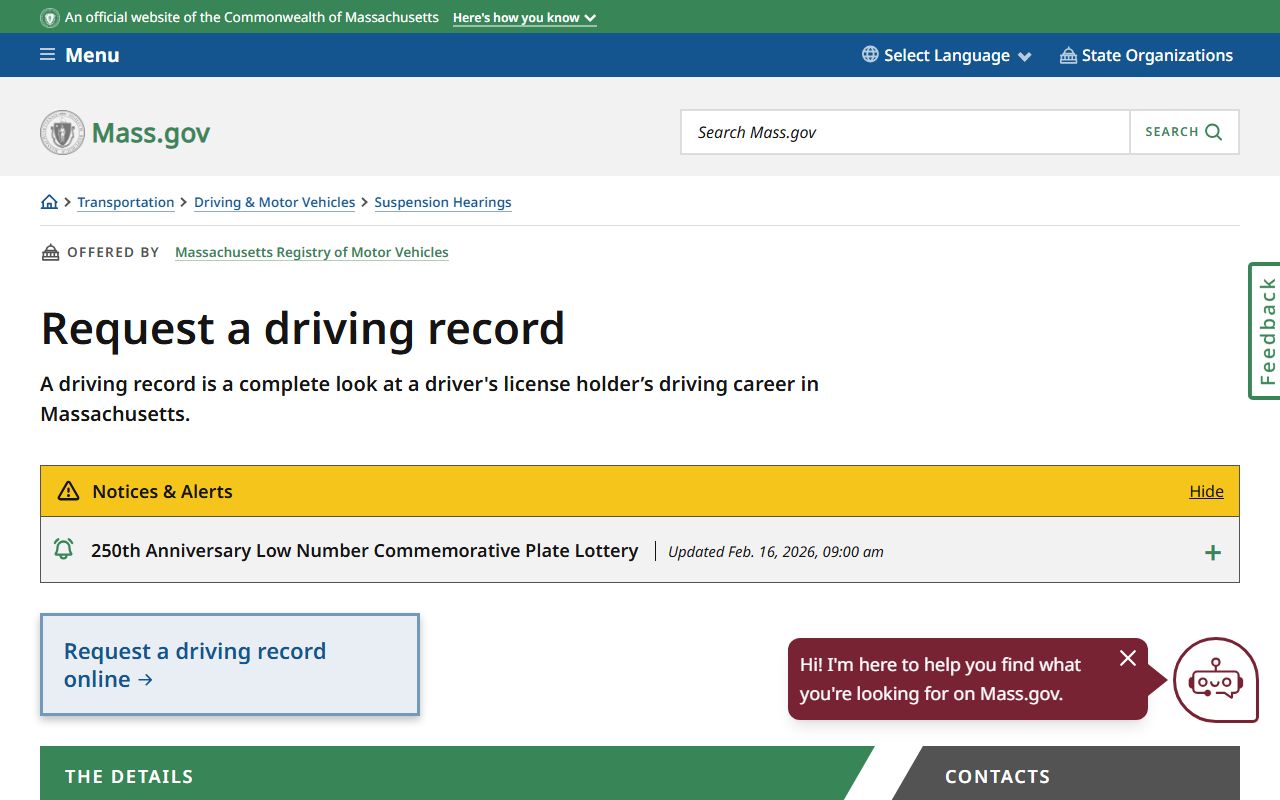
Employers, insurance companies, and courts may request your driving record, so it is worth reviewing it periodically to make sure the information is correct.
The MyRMV portal lets you see your own record without paying for a formal copy.
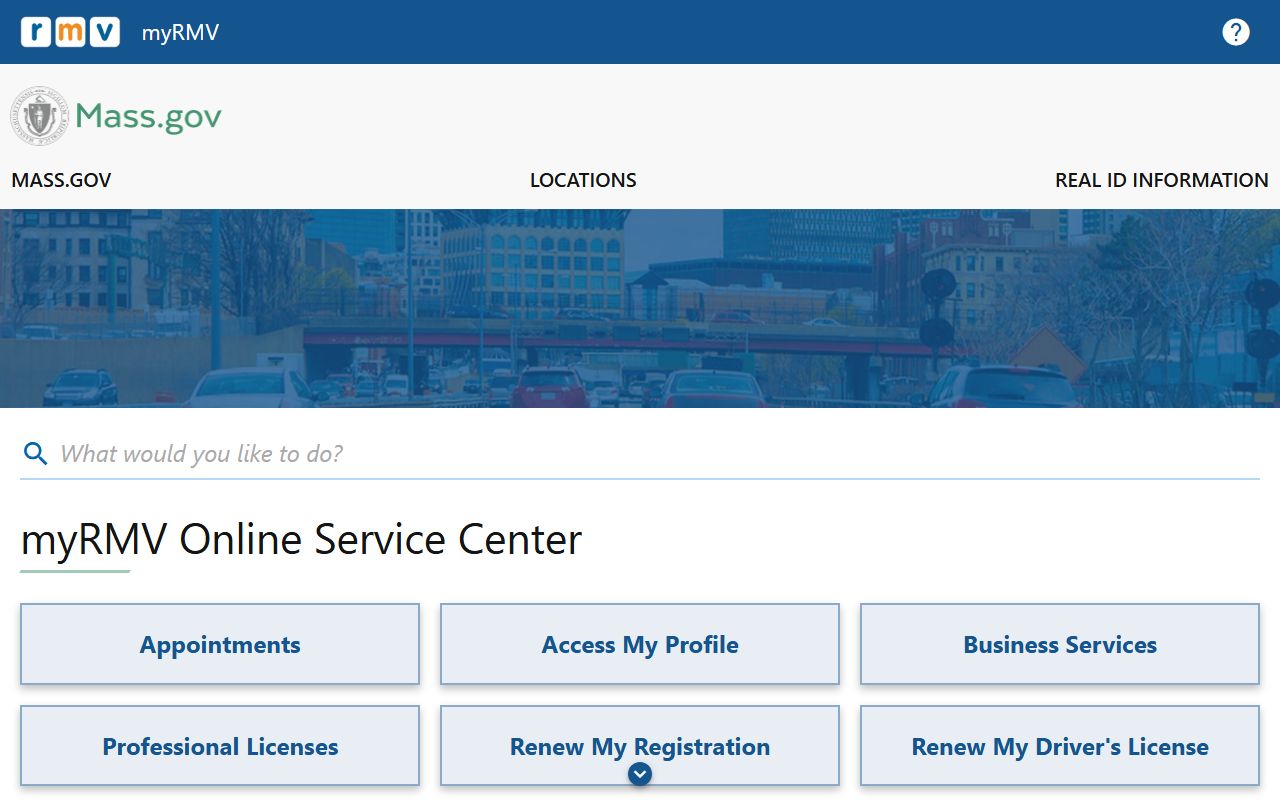
Log in at MyRMV with your Mass.gov credentials to check your license status and view recent activity on your record.
Surchargeable Events and Massachusetts Traffic Ticket Records
Not every traffic ticket in Massachusetts shows up the same way on your record. The state divides violations into surchargeable and non-surchargeable events. Surchargeable events affect your insurance rates through the Safe Driver Insurance Plan (SDIP), administered by the Merit Rating Board (MRB). The surchargeable incidents page lists exactly which violations count. Minor moving violations add 2 points to your record. A minor at-fault accident adds 3 points. Major at-fault accidents add 4 points, and major violations add 5 points. These points feed directly into how insurers calculate your premium.
The surcharge system page details which violations trigger insurance consequences.
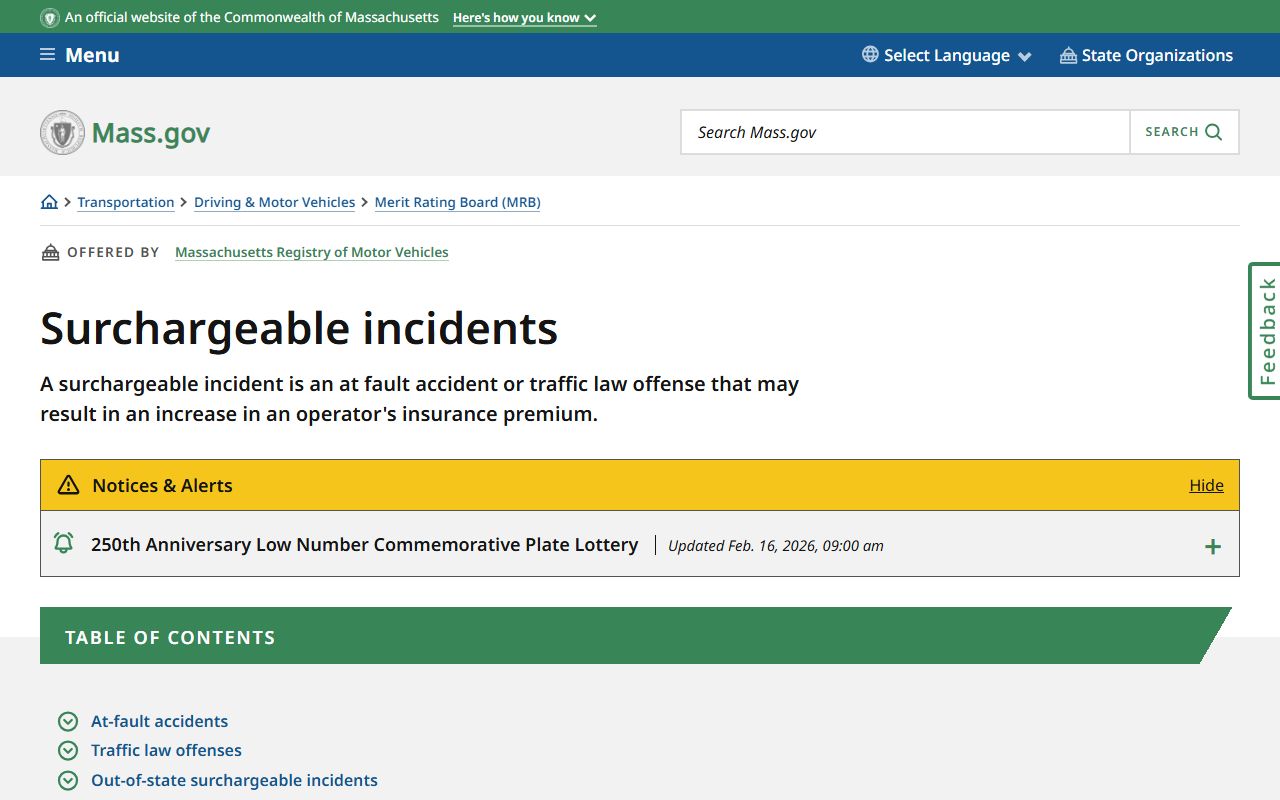
Knowing whether your ticket is surchargeable before deciding whether to pay or appeal can save you money on premiums in the long run.
Accumulating too many surchargeable events triggers automatic action. Three surchargeable events within 24 months requires you to complete a Driver Retraining program within 90 days. Three speeding tickets in a 12-month period results in an automatic 30-day license suspension under MGL c. 90, Section 20. Seven surchargeable events within 36 months brings a 60-day suspension. Habitual offenders face the harshest consequences: three major violations or 12 violations of any kind within 60 months can lead to a four-year suspension under MGL c. 90, Section 22F. The suspensions from multiple offenses page covers all these thresholds in detail.
Details on automatic suspensions are explained further on the license suspensions page.
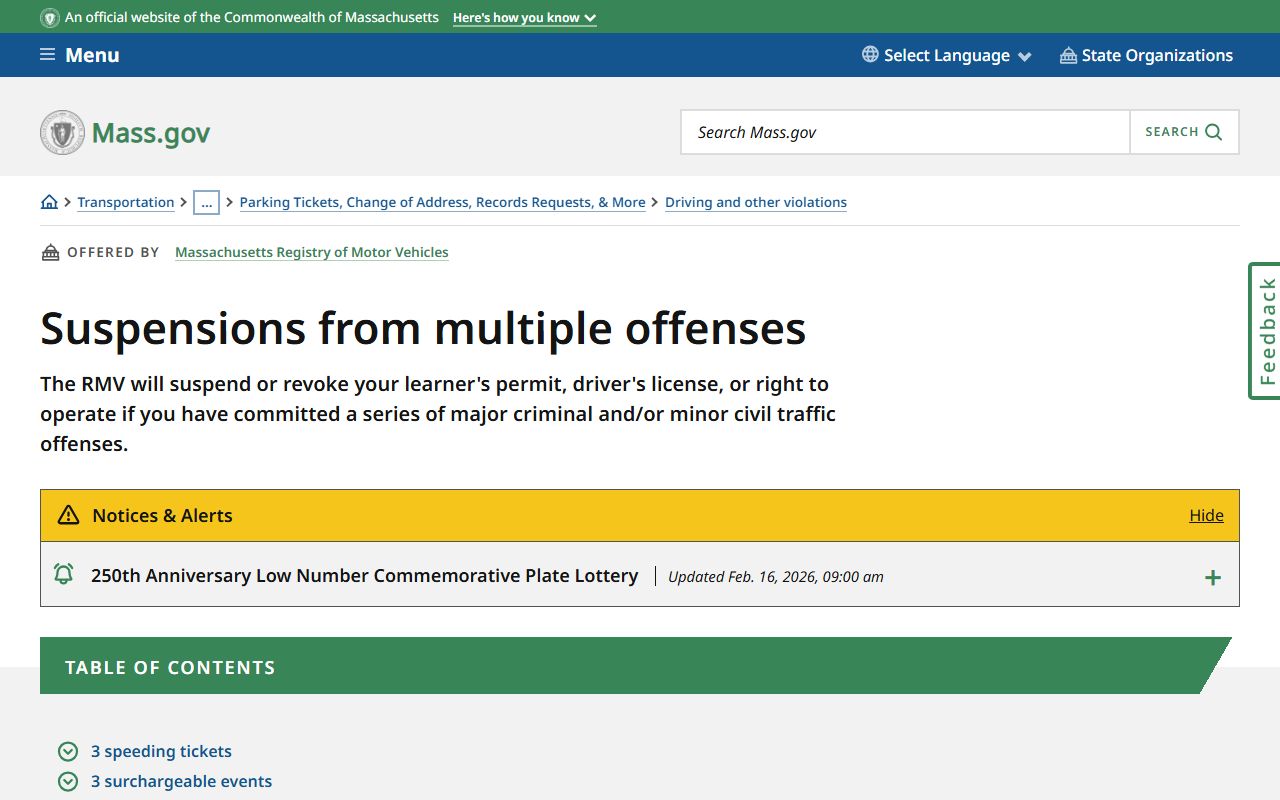
If your license has been suspended due to multiple violations, the RMV suspension page explains what steps you need to take to get it reinstated.
Massachusetts Traffic Laws and Violations
Massachusetts law sets specific fines for common moving violations. Speeding fines start at $50 for driving 1 to 10 mph over the limit. For speeds 11 or more mph over the limit, the base fine is $50 plus $10 for each additional mph. So going 20 mph over costs $150. Every ticket also carries a $50 Head Injury Treatment Services Trust Fund surcharge. Details on speeding fines are on the Massachusetts speed limits law page. The full traffic statute framework lives under MGL Chapter 90, which covers all motor vehicle operation rules.
The Hands-Free Law took effect February 23, 2020. Using a handheld phone while driving is now illegal in Massachusetts. First offense: $100. Second offense: $250. Third and any later offense: $500. All Hands-Free violations are surchargeable. That means they will affect your insurance rates just like speeding or running a red light. For OUI offenses, the legal blood alcohol limit is 0.08% for drivers 21 and older, 0.02% for drivers under 21, and 0.04% for commercial vehicle operators. A first OUI conviction carries a fine of $500 to $5,000, up to 2.5 years in jail, and a one-year license suspension. More on the legal framework is available at mass.gov/info-details/massachusetts-law-about-traffic-violations.
Construction zone violations carry higher penalties. Fines double in active work zones where workers are present. This applies to speeding, passing, and other moving violations. Courts take work zone tickets seriously, and officers often focus enforcement efforts in those areas during active construction periods.
Browse Massachusetts Traffic Ticket Records by County
Each county in Massachusetts has district courts that handle traffic ticket hearings. Pick a county to find local court contact info and traffic citation resources.
Traffic Ticket Records in Major Massachusetts Cities
Residents of major Massachusetts cities can look up traffic ticket records at their local district court. Select a city below to find court info and citation resources.